Showing posts with label BLUETOOTH. Show all posts

Bluetooth ,wireless technology

Bluetooth is a wireless technology standard for exchanging data over short distances (using short-wavelength UHF radio waves in the ISM band from 2.4 to 2.485 GHz[2]) from fixed and mobile devices, and building personal area networks (PANs). Invented by telecom vendor Ericsson in 1994, it was originally conceived as a wireless alternative to RS-232 data cables. It can connect several devices, overcoming problems of synchronization.

Bluetooth is managed by the Bluetooth Special Interest Group (SIG), which has more than 19,000 member companies in the areas of telecommunication, computing, networking, and consumer electronics. Bluetooth was standardized as IEEE 802.15.1, but the standard is no longer maintained. The SIG oversees the development of the specification, manages the qualification program, and protects the trademarks.[5] To be marketed as a Bluetooth device, it must be qualified to standards defined by the SIG. A network of patents is required to implement the technology, which is licensed only for that qualifying device.
 List of applications
  • A typical Bluetooth mobile phone headset.
  •     Wireless control of and communication between a mobile phone and a handsfree headset. This was one of the earliest applications to become popular.
  •     Wireless control of and communication between a mobile phone and a Bluetooth compatible car stereo system.
  •     Wireless control of and communication with tablets and speakers such as iPad and Android devices.
  •     Wireless Bluetooth headset and Intercom. Idiomatically, a headset is sometimes called "a Bluetooth".
  •     Wireless networking between PCs in a confined space and where little bandwidth is required.
  •     Wireless communication with PC input and output devices, the most common being the mouse, keyboard and printer.
  •     Transfer of files, contact details, calendar appointments, and reminders between devices with OBEX.
  •     Replacement of previous wired RS-232 serial communications in test equipment, GPS receivers, medical equipment, bar code scanners, and traffic control devices.
  •     For controls where infrared was often used.
  •     For low bandwidth applications where higher USB bandwidth is not required and cable-free connection desired.
  •     Sending small advertisements from Bluetooth-enabled advertising hoardings to other, discoverable, Bluetooth devices.[21]
  •     Wireless bridge between two Industrial Ethernet (e.g., PROFINET) networks.
  •     Three seventh and eighth generation game consoles, Nintendo's Wii.[22] and Sony's PlayStation 3, use Bluetooth for their respective wireless controllers.
  •     Dial-up internet access on personal computers or PDAs using a data-capable mobile phone as a wireless modem.
  •     Short range transmission of health sensor data from medical devices to mobile phone, set-top box or dedicated telehealth devices.[23]
  •     Allowing a DECT phone to ring and answer calls on behalf of a nearby mobile phone.

click for more bluetooth note
MOre Bluetooth

• Bluetooth is a wireless LAN technology used to connect devices of different functions such as telephones, computers (laptop or desktop), notebooks, cameras, printers and so on.
• Bluetooth project was started by SIG (Special Interest Group) formed by four companies - IBM, Intel, Nokia and Toshiba for interconnecting computing and communicating devices using short-range, lower-power, inexpensive wireless radios.
• The project was named Bluetooth after the name of Viking king – Harald Blaatand who unified Denmark and Norway in 10th century.
• Nowadays, Bluetooth technology is used for several computer and non computer application:
1. It is used for providing communication between peripheral devices like wireless mouse or keyboard with the computer.
2. It is used by modern healthcare devices to send signals to monitors.
3. It is used by modern communicating devices like mobile phone, PDAs, palmtops etc to transfer data rapidly.
4. It is used for dial up networking. Thus allowing a notebook computer to call via a mobile phone.
5. It is used for cordless telephoning to connect a handset and its local base station.
6. It also allows hands-free voice comml1nication with headset.
7. It also enables a mobile computer to connect to a fixed LAN.
8. It can also be used for file transfer operations from one mobile phone to another.
Bluetooth devices have a built-in short range radio transmitter. The rate provided is 1Mbps and uses 2.4 GHz bandwidth.

Bluetooth Architecture

Bluetooth architecture defines two types of networks:
 
1. Piconet
2. Scattemet
 

1. Piconet

 
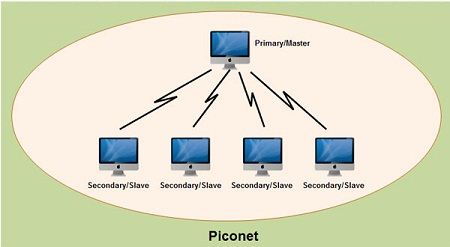
• Piconet is a Bluetooth network that consists of one primary (master) node and seven active secondary (slave) nodes.
• Thus, piconet can have upto eight active nodes (1 master and 7 slaves) or stations within the distance of 10 meters.
• There can be only one primary or master station in each piconet.
• The communication between the primary and the secondary can be one-to-one or one-to-many.
                       Piconet
• All communication is between master and a slave. Salve-slave communication is not possible.
• In addition to seven active slave station, a piconet can have upto 255 parked nodes. These parked nodes are secondary or slave stations and cannot take part in communication until it is moved from parked state to active state.

2. Scatternet

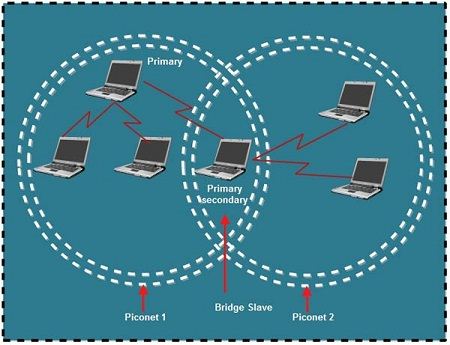
• Scattemet is formed by combining various piconets.
• A slave in one piconet can act as a master or primary in other piconet.
• Such a station or node can receive messages from the master in the first piconet and deliver the message to its slaves in other piconet where it is acting as master. This node is also called bridge slave.
• Thus a station can be a member of two piconets.
• A station cannot be a master in two piconets.
                               Scatternet

Bluetooth layers and Protocol Stack

 
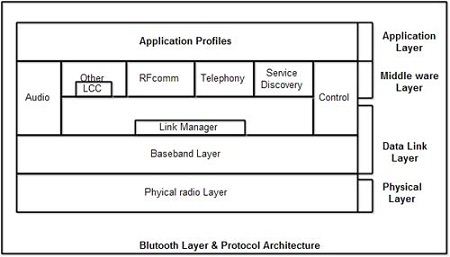
• Bluetooth standard has many protocols that are organized into different layers.
• The layer structure of Bluetooth does not follow OS1 model, TCP/IP model or any other known model.
• The different layers and Bluetooth protocol architecture.
                                Bluetooth layers and protocol architecture
Radio Layer
 
• The Bluetooth radio layer corresponds to the physical layer of OSI model.
• It deals with ratio transmission and modulation.
• The radio layer moves data from master to slave or vice versa.
• It is a low power system that uses 2.4 GHz ISM band in a range of 10 meters.
• This band is divided into 79 channels of 1MHz each. Bluetooth uses the Frequency Hopping Spread Spectrum (FHSS) method in the physical layer to avoid interference from other devices or networks.
• Bluetooth hops 1600 times per second, i.e. each device changes its modulation frequency 1600 times per second.
• In order to change bits into a signal, it uses a version of FSK called GFSK i.e. FSK with Gaussian bandwidth filtering.
 
Baseband Layer
 
• Baseband layer is equivalent to the MAC sublayer in LANs.
• Bluetooth uses a form of TDMA called TDD-TDMA (time division duplex TDMA).
• Master and slave stations communicate with each other using time slots.
• The master in each piconet defines the time slot of 625 µsec.
• In TDD- TDMA, communication is half duplex in which receiver can send and receive data but not at the same time.
• If the piconet has only no slave; the master uses even numbered slots (0, 2, 4, ...) and the slave uses odd-numbered slots (1, 3, 5, .... ). Both master and slave communicate in half duplex mode. In slot 0, master sends & secondary receives; in slot 1, secondary sends and primary receives.
• If piconet has more than one slave, the master uses even numbered slots. The slave sends in the next odd-numbered slot if the packet in the previous slot was addressed to it.
• In Baseband layer, two types of links can be created between a master and slave. These are:
 
1. Asynchronous Connection-less (ACL)
 
• It is used for packet switched data that is available at irregular intervals.
• ACL delivers traffic on a best effort basis. Frames can be lost & may have to be retransmitted.
• A slave can have only one ACL link to its master.
• Thus ACL link is used where correct delivery is preferred over fast delivery.
• The ACL can achieve a maximum data rate of 721 kbps by using one, three or more slots.
2. Synchronous Connection Oriented (SCO)
• sco is used for real time data such as sound. It is used where fast delivery is preferred over accurate delivery.
• In an sco link, a physical link is created between the master and slave by reserving specific slots at regular intervals.
• Damaged packet; are not retransmitted over sco links.
• A slave can have three sco links with the master and can send data at 64 Kbps.
Logical Link, Control Adaptation Protocol Layer (L2CAP)
 
• The logical unit link control adaptation protocol is equivalent to logical link control sublayer of LAN.
• The ACL link uses L2CAP for data exchange but sco channel does not use it.
• The various function of L2CAP is:
1. Segmentation and reassembly
 
• L2CAP receives the packets of upto 64 KB from upper layers and divides them into frames for transmission.
• It adds extra information to define the location of frame in the original packet.
• The L2CAP reassembles the frame into packets again at the destination.
 
2. Multiplexing
 
• L2CAP performs multiplexing at sender side and demultiplexing at receiver side.
• At the sender site, it accepts data from one of the upper layer protocols frames them and deliver them to the Baseband layer.
• At the receiver site, it accepts a frame from the baseband layer, extracts the data, and delivers them to the appropriate protocol1ayer.
 
3. Quality of Service (QOS)
 
• L2CAP handles quality of service requirements, both when links are established and during normal operation.
• It also enables the devices to negotiate the maximum payload size during connection establishment.
 
Bluetooth Frame Format
 
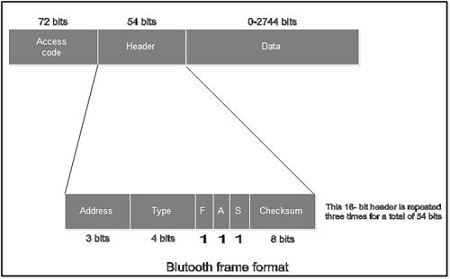
The various fields of blue tooth frame format are:
                                  Bluetooth Frame Format
1. Access Code: It is 72 bit field that contains synchronization bits. It identifies the master.
2. Header: This is 54-bit field. It contain 18 bit pattern that is repeated for 3 time.
The header field contains following subfields:
(i) Address: This 3 bit field can define upto seven slaves (1 to 7). If the address is zero, it is used for broadcast communication from primary to all secondaries.
(ii)Type: This 4 bit field identifies the type of data coming from upper layers.
(iii) F: This flow bit is used for flow control. When set to 1, it means the device is unable to receive more frames.
(iv) A: This bit is used for acknowledgement.
(v) S: This bit contains a sequence number of the frame to detect retransmission. As stop and wait protocol is used, one bit is sufficient.
(vi) Checksum: This 8 bit field contains checksum to detect errors in header.
3. Data: This field can be 0 to 2744 bits long. It contains data or control information coming from upper layers

[REPORT] Smart phone Android Operated Robot ,WIRELESS,BLUETOOTH


Some Importantant links below with reports.just view the link below. if u want any project report just search any project on our search box
Arduino interesting projects:   
Arduino 30 simple and good projects 
Atmega projects lists
Android Electronics projects lists
Rf based Projects with report
engineering study notes 
GSM GPS based projects with report
Bluetooth based projects with reports


Smart phone Android Operated Robot

The project aims in designing a Robot that can be operated using Android mobile
phone. The controlling of the Robot is done wirelessly through Android smart phone
using the Bluetooth feature present in it. Here in the project the Android smart phone is
used as a remote control for operating the Robot.
Android is a software stack for mobile devices that includes an operating system,
middleware and key applications. Android boasts a healthy array of connectivity options,
including Wi-Fi, Bluetooth, and wireless data over a cellular connection (for example,
GPRS, EDGE (Enhanced Data rates for GSM Evolution), and 3G). Android provides
access to a wide range of useful libraries and tools that can be used to build rich
applications. In addition, Android includes a full set of tools that have been built from the
ground up alongside the platform providing developers with high productivity and deep
insight into their applications.
Bluetooth is an open standard specification for a radio frequency (RF)-based,
short-range connectivity technology that promises to change the face of computing and
wireless communication. It is designed to be an inexpensive, wireless networking system
for all classes of portable devices, such as laptops, PDAs (personal digital assistants), and
mobile phones. It also will enable wireless connections for desktop computers, making
connections between monitors, printers, keyboards, and the CPU cable-free.
The controlling device of the whole system is a Microcontroller. Bluetooth
module, DC motors are interfaced to the Microcontroller. The data received by the
Bluetooth module from Android smart phone is fed as input to the controller. The
controller acts accordingly on the DC motors of the Robot. The robot in the project can
be made to move in all the four directions using the Android phone. The direction of the
robot is indicated using LED indicators of the Robot system. In achieving the task the
controller is loaded with a program written using Embedded ‘C’ language.

Proposal Bluetooth based project

ANDROID BASED ELECTRONICS PROJECT

[ Android ] Bluetooth Oscilloscope

Android Bluetooth Oscilloscope


*This application is tested only with Samsung Galaxy GT-i5700 Spica (rooted Android 2.1 OS, i570EXXJD1 Baseband version).
The transmitter circuit uses Microchip's dsPIC33FJ16GS504 for the analog-to-digital conversion of the input signals on two channels. The processed data on the dsPIC are then transmitted to the phone (for waveform display) via the LMX9838 bluetooth SPP module.


specs/ranges:
  • time per division: {5us, 10us, 20us, 50us, 100us, 200us, 500us, 1ms, 2ms, 5ms, 10ms, 20ms, 50ms }
  • volt per division: {10mV, 20mV, 50mV, 100mV, 200mV, 500mV, 1V, 2V, GND}
  • analog input (depends on external pre-amplifier configuration): {-8V to +8V }


The source codes for the bluetooth communication is based on Bluetooth Chat example from http://developer.android.com. That example contains three java source files. And, I've completely copied the "DeviceListActivity.java", which is used for searching remote bluetooth devices. Then I've modified the "BluetoothChatService.java" to use only the RFCOMM Client functions, and used the well-known UUID "00001101-0000-1000-8000-00805F9B34FB" for the Bluetooth RFCOMM/SPP.
 
For the plotting of waveforms, I'm using SurfaceView object to draw on its canvas. This tutorial found on www.helloandroid.com helps me a lot for this task: "How to use canvas in your android".


The rest of the job mainly involves porting of my previous Python S60 script to JAVA language. It was too painful on my side, because I had to convert a single script file to multiple java + xml source files! Nonetheless, it was a good experience for me on learning the Android SDK (JAVA programming).

Project source codes for Android and dsPIC (with APK and HEX) :
AndroidBluetoothOscilloscope.zip

Electronicslab.ph forum link : Android Bluetooth Oscilloscope

Here are some interesting projects that are also based on the Bluetooth Chat example:
Bluetooth Controlled Model Car
SPRIME

Special thanks to:
Samdroid Forum  for the customized/rooted firmwares for our Spica.
Tipidcp Spica users for sharing their tips and experiences with this android phone.

----------------------------------------------------------------------
#edit (10-15-2010)
Here's now my circuit. Nothing special on it, all are based on existing circuits.

*The dsPIC I have used is most probably NOT the best choice for this project because of the many left unused peripherals (extra pins). But, this is the only part readily available in my bin and it has the fastest ADC (2 x 2MSps) among the chips I have.
*If you prefer to change the input range via the op-amp preamp, the computation is located on the "adc.xmcd" file.
*You can use other SPP bluetooth modules aside from LMX. (accdg to manufacturer, it's already obsolete)

----------------------------------------------------------------------
#edit (9-14-2011)

It's almost a year now, and yet some people are still interested in this project (considered to be obsolete). So I've decided to place the source repository also on Google Code site. You can either Browse or use git to have your own local copy:
if u like the post just say thank u in comment box.

[ ANDROID ] Bluetooth Controlled Model Car


Bluetooth Controlled Model Car

15.06.09
Ever since seeing the first bluetooth controlled RC car I wanted to make one. For those who haven't seen it, it used a serial port Bluetooth module (about 200 USD), a "Mini SSC II" serial servo controller board (roughly 50 USD) and an old RC car. . Needless to say it was unnecessarily expensive, which really put me off. So years passed until I suddenly stumbled across some really cheap GP-GC021 bluetooth modules on ebay. (Update: Since then I've found an even cheaper unit which is superior. See the RF-BT0417C) What made them so special was that they were directly TTL compatible UART modules. Not only would I save vast amounts of money, but also effort by not having to use RS-232 voltage levels. I decided to use the RC car from my previous RF control endeavors, but also add servo steering so it would be more fun and practical to use. Given my previous work on the COM laser turret, controlling motors over a serial protocol was no difficulty, and the firm- and software required was already written. The only new thing required would be implementing servo control over a serial protocol.