Routing in Internet
The Origin of Internet
The response of Internet to the issue of choosing routing tables with
complete/par tail information is shown by the following architecture.
There are a few nodes having complete routing information and a large
number of nodes with partial information. The nodes with complete
information, called core gateways, are well connected by a Backbone
Network. These nodes talk to each other to keep themselves updated.
The non-core gateways are connected to the core gateways.
(Historically, this architecture comes from the ARPANET.)
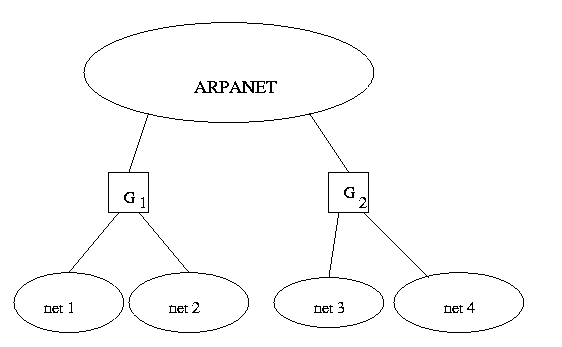
The original internet was structured around a backbone of ARPANET with
several core gateways connected to it .These core gateways connected
some Local Area Networks (LANs) to the rest of the network. These
core gateways talked to themselves and exchanged routing
information's. Every core gateway contained complete information
about all possible destinations.
How do you do routing ?
The usual IP routing algorithm employs an internet routing table (some
times called an IP routing table) on each machine that Stores the
information about the possible destinations, and how to reach them.
Default Routes
This technique used to hide information and keep routing table size small
consolidates multiple entries into a default case. If no route
appears in the routing table, the routing routine sends the data gram
to the
default router.
Default routing is especially useful when a site has a small set of local addresses and only one
connection to the rest of the internet.
Host-Specific Routes
Most IP routing software allows per-host routes to be specified as a
special case. Having per-host routes gives the local network
administrator more control over network use, permits testing, and can
also be used to control access for security purposes. when debugging
network connections or routing tables, the ability to specify a
special route to one individual machine turns out to be especially
useful.
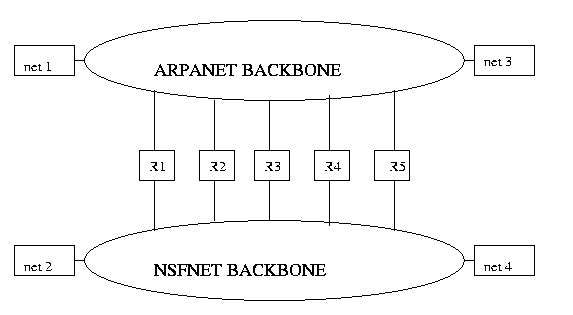
Internet with Two Backbones